

This is what close looks like.
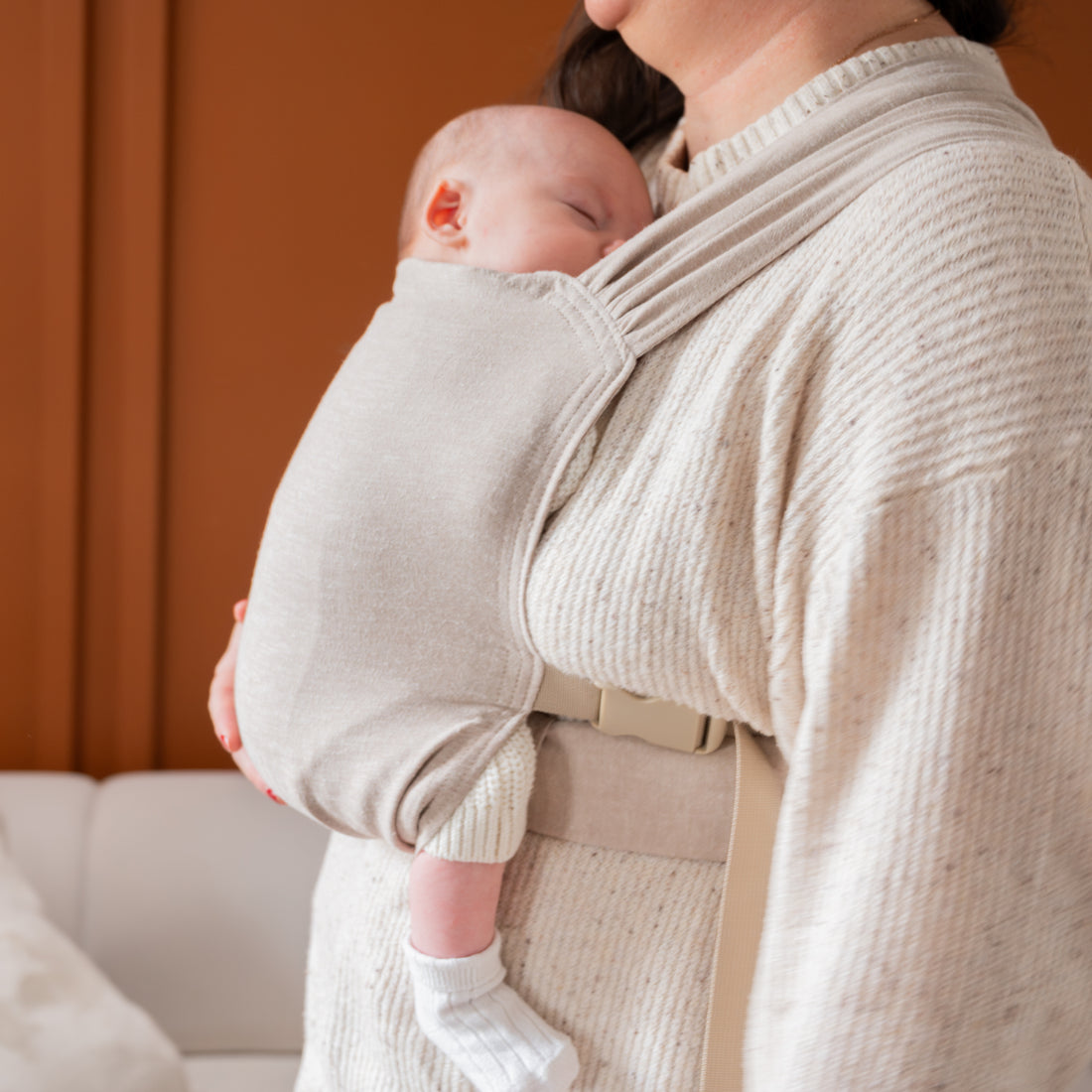
Watch how the Sprout holds your newborn in their natural position. Close, secure, and exactly where they want to be.
Check out the features
Tap a dot to explore the features.
Holds its shape.
No sagging.
Stretchy carriers feel soft but sag under a newborn's weight. The Sprout's woven fabric holds its shape from the first buckle to the last. Consistent support every wear, no second-guessing, no readjusting.
Sized for
a newborn body.
Panel proportions built around your baby's natural C-curve spine from day one. No insert needed. No adapting. Just a carrier that understands how small, curled-up newborns actually sit.
Above your incision.
Not on it.
The apron-style waistband sits higher on your torso, well away from c-section incisions and sensitive postpartum recovery areas. A small detail that makes a real difference in those early weeks.
Distributes weight.
All day long.
The x-back strap design spreads your newborn's weight across both shoulders and your upper back. Comfortable for 20 minutes or all afternoon, even in those early weeks when you barely put them down.
Ready for the best newborn cuddles?
You've got them. We've got you.
No insert required.
7 to 24 Pounds
Postpartum-friendly design.
Woven, not stretchy.
From parents who've been there.
Real reasons. Not the fluffy ones.
Pick your situation.
A landmark study had parents carry their babies three extra hours a day. Crying dropped 43% overall, and 54% at night.
Physical closeness regulates cortisol, stabilizes heart rate, and recreates the warmth your baby knew before birth. The fourth trimester is real. A carrier is one of the few tools actually designed for it.
Hunziker & Barr, Pediatrics, 1986 — one of the most replicated studies in infant care research.
Carrying upright counts as tummy time. It works the same neck, back, and core muscles without the floor protests. The M-position is endorsed by the International Hip Dysplasia Institute.
Babies in carriers are also at adult eye level. They hear real conversation, see faces, and experience the world as you move through it. That's what early cognitive development actually looks like.
M-position endorsed by the International Hip Dysplasia Institute.
A well-designed carrier distributes weight across your hips and both shoulders, not just your lower back.
The difference between a good carrier and a cheap one is the difference between all-day wear and giving up after 20 minutes.
Gravity helps with reflux. Being upright, at your chest, keeps acid down in a way no swing or bouncer can replicate.
The rhythmic motion of walking does something to the nervous system that is genuinely hard to manufacture any other way. For reflux and colic, babywearing is often the first thing that works.
Swings, bouncers, rockers: those are containers. A carrier is the opposite. Your baby moves when you move, hears what you hear, stays engaged while you get things done.
It also means no stroller. Airports, farmers markets, cobblestone streets: a carrier goes everywhere a stroller turns into a negotiation.
Our Sprout Newborn Carriers are built for discreet on-the-go nursing. Adjust, feed, keep walking. No hunting for a bench, no cover fumbling.
Skin-to-skin during nursing boosts oxytocin for both of you, supporting milk supply and bonding at the same time. The science and the practicality line up here.
Skin-to-skin contact triggers oxytocin, the bonding hormone, in the parent, not just the baby. Consistently elevated oxytocin is linked to lower rates of postpartum anxiety and depression.
That's not therapy and it's not a cure. But it's a real physiological mechanism. If you're struggling, it's worth knowing the carrier you just ordered is also doing something for you.
Feldman et al. on kangaroo care and parental oxytocin; multiple studies linking skin-to-skin contact to reduced postpartum anxiety scores.
Built different. On purpose.
Every detail is specific to the newborn stage, and the parent living through it.
Most carriers are built to grow with your baby from birth to toddlerhood. The Sprout does one thing: fits newborns perfectly from day one. Panel proportions designed for tiny bodies. A weight range that starts at 7 pounds. No inserts, no adapters, no workarounds.
Stretchy carriers feel soft but lose their shape within minutes. The Sprout uses woven fabric offering structured support that holds your baby securely for as long as you need it. No second-guessing whether you've tightened enough. No readjusting mid-errand.
The apron-style waistband sits higher on your torso: above a C-section incision, away from sensitive postpartum areas. Designed by parents who understood that the person wearing the carrier is also recovering. No waistband digging in where it hurts most.
Despite being fully structured and supportive, the Sprout packs down to fit in your diaper bag or your fanny pack. Keep it in the car, bring it everywhere. When your baby needs to be held and you're not at home, it's there.
Frequently Asked Questions
What's the weight range?
The Sprout is designed for babies 7 to 24 pounds, from birth through around 6 to 9 months, depending on your baby's size. Once they outgrow it, the Lark Baby Carrier picks up right where the Sprout leaves off!
Is it safe to use from birth?
Yes, as long as your baby weighs at least 7 pounds and there are no medical concerns. The Sprout supports their natural C-curve spine, keeps their airway clear, and positions their hips correctly from day one. Not sure you've got it right? We offer free fit checks!
How is it different from the Lark?
The Lark is built to grow with your baby from 10 to 45 pounds once your baby fits into size 3-6m tops. The Sprout is designed specifically for newborns with a smaller panel, less padding, and woven fabric that molds to a tiny body. No insert needed because it doesn't have to pretend to be something it's not. Many families have both.
How do I know which length to choose?
Two lengths based on your fitted shirt size: Short for XXS through L, Long for XL through 6X.
Check our length guide or email us your size and we'll tell you exactly which one to get.
What carry positions does it offer?
The Sprout is designed for front carry with x-back straps, which provides optimal weight distribution across your shoulders and back. The x-back design is particularly comfortable for the newborn stage when you're wearing baby frequently throughout the day.
Find your carrier